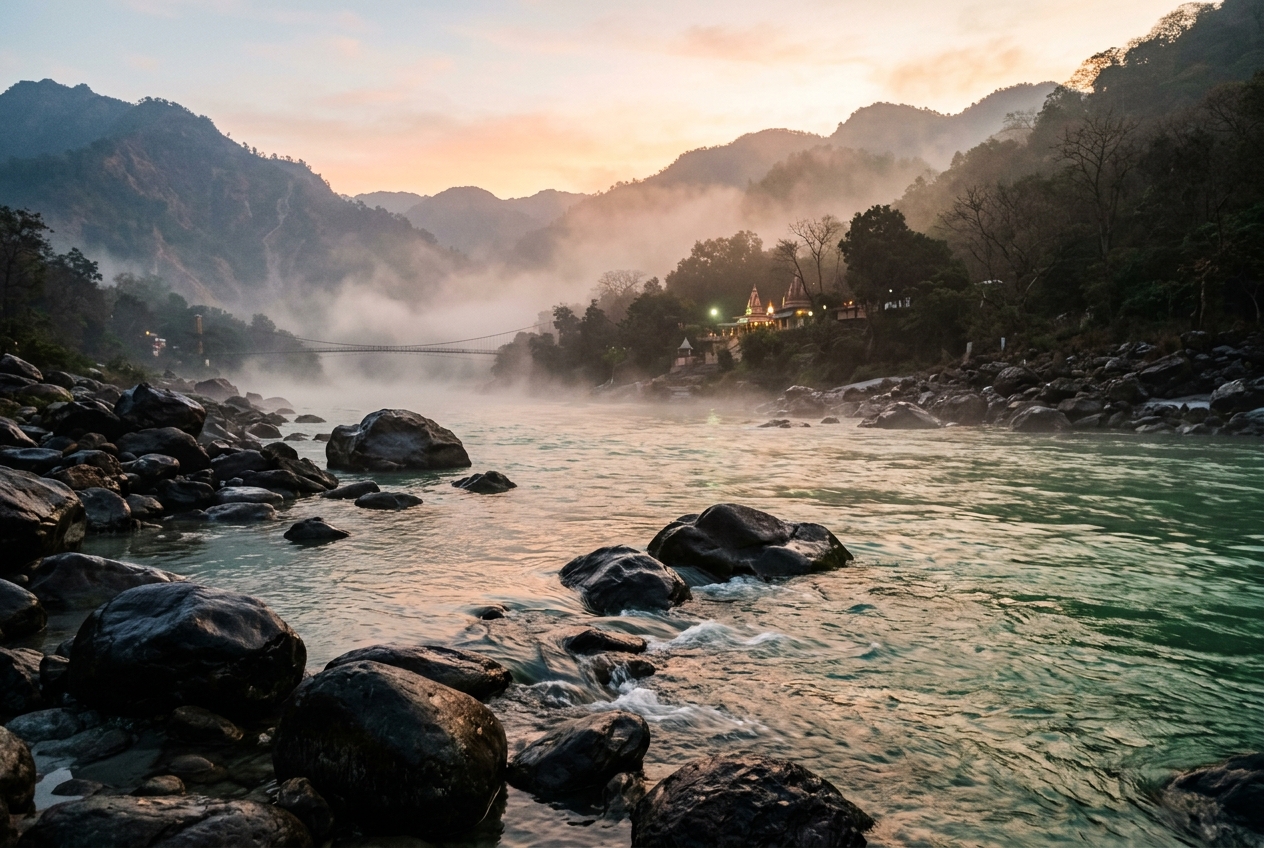
Nestled in the foothills of the Himalayas where the emerald-green Ganges River leaves the mountains, Rishikesh is a global center for yoga and spiritual seekers. It is a city of bells, prayers, and cold currents. To travel here mindfully is to step off the tour buses and engage with the natural features of the land: the massive rocks, the pine forests, and the powerful flow of the sacred river.
This guide details the quiet spaces of Rishikesh, outlining how to navigate its ashrams, mountain trails, and riverbank meditation spots while cultivating presence.
---
At A Glance: Seeker's Guide to Rishikesh
For travelers seeking to quiet their minds and explore the spiritual landscape of Rishikesh, this table outlines key locations and mindful habits:
| Question | Direct Answer | Recommended Practice |
| :--- | :--- | :--- |
| **What makes the Ganges in Rishikesh unique?** | It is clean, cold, and fast-flowing, direct from the Himalayan glaciers. | Sit quietly on the white sand beaches near Tapovan at sunrise. |
| **Where can I find silent meditation spaces?** | In Swarg Ashram’s quiet gardens or the historic Beatles Ashram ruins. | Practice [Meditation on the Road](/essays/mindfulness/meditation-on-the-road) inside the stone domes. |
| **How do I handle the intense city noise?** | Use the white noise of the river and practice [Somatic Resourcing](/essays/mindfulness/somatic-resourcing). | Walk along the eastern bank of the river early in the morning. |
| **What is the Ganga Aarti?** | A daily devotional fire ceremony performed on the riverbanks. | Stand at the edge of the crowd; focus on the flame transitions. |
---
The Silent East Bank: Swarg Ashram and Beyond
The town of Rishikesh is divided by the Ganges and connected by suspension bridges (Laxman Jhula and Ram Jhula). The western bank is bustling and commercial, filled with cafes, shops, and traffic. The eastern bank (Swarg Ashram area) is closed to motor vehicles, offering a quieter, more traditional atmosphere.
The Soundscape of Swarg Ashram
Walking through the eastern lanes in the early morning, you hear:
* The high, metallic ring of temple bells.
* The low chant of *Om* coming from open meditation halls.
* The rush of the wind coming down from the Himalayan valleys.
To practice mindfulness here, you do not need a quiet room. You can walk slowly along the pathways, letting your attention shift from one sound to another without holding onto them. This practice of "open monitoring" is an excellent way to prepare your mind before sitting down for formal meditation.
---
Contemplation inside the Beatles Ashram
In 1968, the Beatles visited the ashram of Maharishi Mahesh Yogi in Rishikesh to study Transcendental Meditation. Today, the ashram is managed by the forest department as a eco-sanctuary, filled with overgrown jungle, pine trees, and ruins.
The most striking feature of the ashram is the rows of stone meditation caves built from river stones.
* **The Stone Domes**: Step inside one of the double-story stone domes. Notice the temperature drop immediately. The thick stone walls block out the sounds of the jungle, creating a silent chamber.
* **Mindfulness Practice**: Sit comfortably on the stone floor. Notice the darkness and the absolute stillness. This is an ideal space to practice [Meditation on the Road](/essays/mindfulness/meditation-on-the-road). Focus on the rise and fall of your chest. The dome architecture amplifies the sound of your own breathing, acting as a natural auditory anchor.
"In the ruins of the Beatles Ashram, the jungle is slowly reclaiming the stone. It is a physical lesson in impermanence—what we build eventually returns to the earth." — Akhi
---
The River as an Anchor: Sand Beach Grounding
The Ganges in Rishikesh (known locally as the Ganga) is not just water; it is a powerful presence. The river water is glacier-melt, running cold, clear, and emerald-green.
Along the eastern bank, near the area of Tapovan, are wide stretches of white sand beaches framed by large, dark boulders.
* **Sunrise Grounding**: Wake up before dawn and walk to a secluded patch of sand. Sit on a flat boulder. Watch the mist rise off the river water. The temperature difference between the cold water and the warm morning air creates a layer of fog that dances across the surface.
* **Somatic Touch**: Dip your fingers into the cold water. The sudden cold triggers a mild shock to the nervous system, activating the vagus nerve and bringing your focus immediately to the physical present. Feel the texture of the white river sand between your fingers, noting its fine grain.
* **River Meditation**: Look at the flow of the water. Notice how the river adapts to the boulders: it does not fight the rock; it flows around it. Let this be a visual metaphor for your thoughts. When an anxious thought arises, do not fight it; let it flow past like water around a stone.
---
Navigating the Ganga Aarti: A Sensory Devotion
Every evening during sunset, ashrams along the river perform the *Ganga Aarti*—a fire ritual of thanksgiving to the river goddess. The most famous ceremonies occur at Parmarth Niketan and Triveni Ghat.
The ritual is a rich sensory experience:
1. **Sight**: The glow of brass lamps containing oil and camphor fires. The reflection of flames on the dark water of the river.
2. **Sound**: The collective chanting of prayers, playing of harmoniums, and blowing of conch shells.
3. **Smell**: The thick aroma of incense, burning ghee, and sandalwood paste floating on the evening breeze.
For the mindful traveler, the *Aarti* can be an intense experience. If the crowd becomes too dense, stand at the back. Lean your back against a stone wall, feel the physical support, and focus your attention on the single flame of the main lamp. Watch the flame rise, flicker, and dance, letting it anchor your visual attention.
---
Concluding Thoughts
Rishikesh teaches us that spirituality is not an abstract concept; it is connected to the land. By stepping into the stone domes of the Beatles Ashram, sitting on the cold sands of the Ganges, and walking the silent lanes of the eastern bank, you connect with the ancient quiet of the Himalayas. In this space, the rushing river becomes a reminder of flow, and the silent peaks become a reminder of your own capacity for stillness.