Kerala, located on India's tropical Malabar Coast, is known as \"God's Own Country.\" Its backwaters—a labyrinthine network of brackish lagoons, lakes, and canals—offer a slow, floating sanctuary. To travel here mindfully is to step off the fast-paced tourist routes and enter a world where transportation is measured by the pole of a canoe and the daily schedule is dictated by the sunrise and the monsoon tides.
This guide explores the quiet backwaters of Kerala, highlighting how to slow down your pace, experience traditional village life, and integrate Ayurvedic grounding habits during your stay.
---
At A Glance: Slow Travel Guide to Kerala Backwaters
For travelers seeking to relax and experience the floating rhythms of Kerala, this table outlines key aspects and wellness integrations:
| Question | Direct Answer | Recommended Practice |
| :--- | :--- | :--- |
| **What are the Kerala Backwaters?** | A 900 km network of palm-lined waterways, canals, and lakes in southwestern India. | Choose Kumarakom or Monroe Island for a quieter, less commercial experience. |
| **Why is Kerala a center for Ayurveda?** | The humid, tropical climate is ideal for herbal growth and body purification therapies. | Schedule a traditional consultation to balance your system; read our [Ayurveda Travel Tips](/essays/wellness/ayurveda-travel-tips). |
| **How do I find local plant-based meals?** | Kerala cuisine is naturally rich in coconut, vegetables, and rice. | Eat a traditional sadhya served on a banana leaf; learn [Vegan Travel Hacks](/essays/wellness/vegan-travel-hacks) for menu checking. |
| **What is a Kettuvallam?** | A traditional wood-and-thatch houseboat historically used to transport rice. | Choose a manually poled wooden canoe to explore narrow canals quietly. |
---
The Pace of the Canal: Canoe over Houseboat
The backwaters are famous for their large, luxurious houseboats (*Kettuvallams*). While houseboats offer a comfortable stay, their diesel engines create noise and water pollution, and their size prevents them from entering the narrow, quiet canals where local life actually takes place.
The Wooden Canoe Experience
To truly feel the backwaters, hire a small, manually poled wooden canoe.
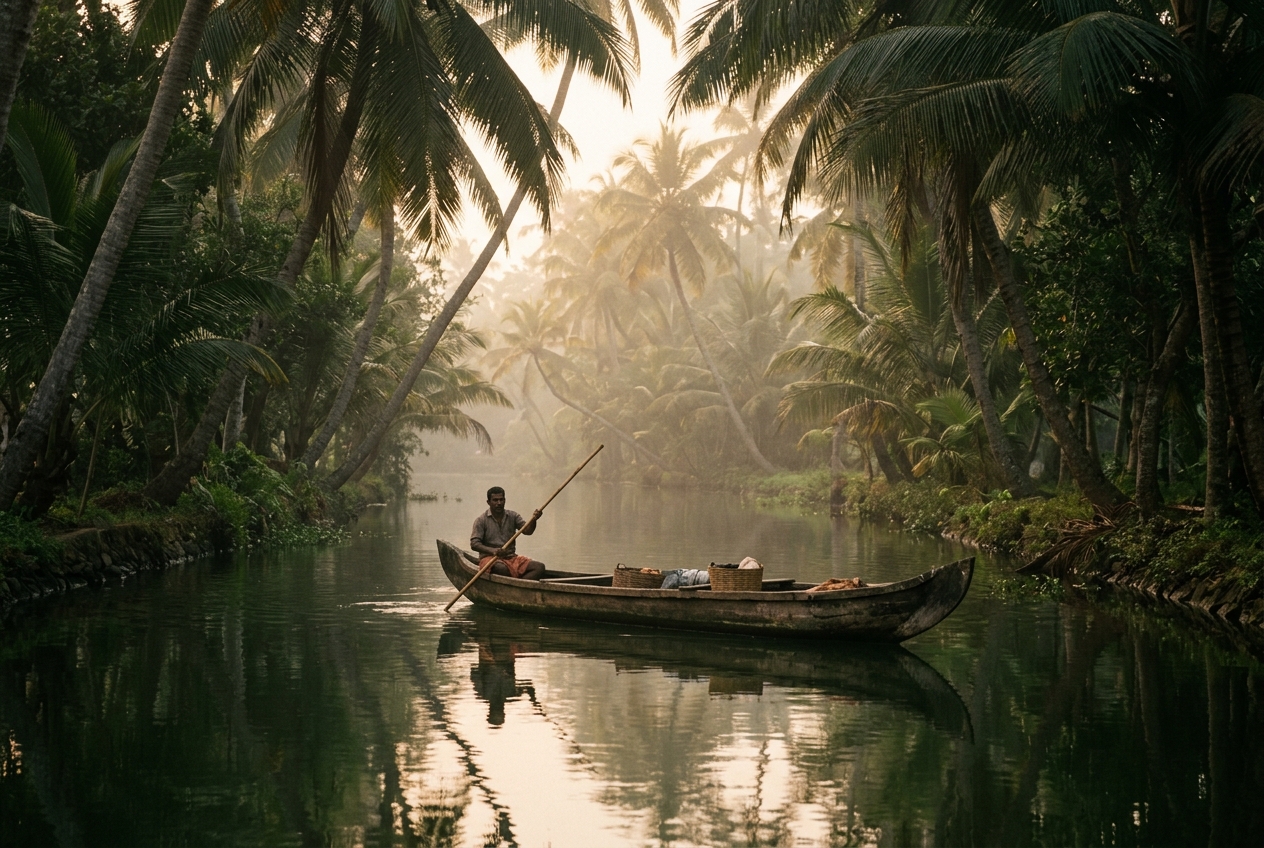
* **The Metronome of the Water**: In a canoe, the engine is replaced by a long bamboo pole pushed against the canal bed by a local boatman. The boat moves at the speed of a slow walk (about 3 to 4 km/h). The only sounds are the drip of water from the pole and the call of white-throated kingfishers.
* **Observing Village Life**: Because the canoe is silent and low in the water, you can observe the daily rhythms of the canal-side villages without disrupting them. Watch women washing clothes on stone steps, ducks swimming in neat lines, and fishermen casting hand nets.
* **Presence Practice**: Sit quietly on the wooden slat of the canoe. Let your hands rest in your lap. Focus your attention on the surface of the water. Notice the reflection of the coconut palms bending over the canal, and how the canoe's ripples distort and reform the green reflection.
---
Kumarakom and Monroe Island: Sourcing Solitude
Most travelers head directly to Alleppey (Alappuzha), which has become crowded with hundreds of motorized houseboats. To find quiet and solitude, choose less commercial zones:
The Tranquility of Kumarakom
Located on the banks of Vembanad Lake, Kumarakom is a cluster of little islands.
* **Bird Sanctuary Walk**: Wake up at 6:00 AM to visit the Kumarakom Bird Sanctuary. Walk along the dirt pathways surrounded by rubber trees and marshlands. The sanctuary is a quiet haven for migratory birds. Stop, close your eyes, and try to distinguish the call of the Siberian Crane from local herons.
* **Open Lake Views**: The sheer scale of Vembanad Lake offers a sense of spatial expansion. Sit at the edge of a jetty, look out at the flat horizon of water, and let your lungs expand in synchronization with the open space.
Monroe Island (Munroe Island)
Monroe Island is a group of eight islands surrounded by the Ashtamudi Lake and Kallada River.
* It is a sleepy destination where the main industries are coconut coir weaving and prawn farming.
* Walk or cycle through the narrow island paths. The canopy of coconut palms filters the tropical sun, creating cool, green tunnels. Stop to watch local artisans spin coconut fiber into ropes, noting the rhythm and focus of their hands.
---
Grounding Through Ayurveda: The Panchakarma Legacy
Kerala is the historical home of Ayurveda, the ancient Indian system of medicine. The warm, humid climate of the Malabar Coast keeps the body's pores open, making it the ideal environment for detoxification and rejuvenation treatments.
The Abhyanga Massage
One of the core Ayurvedic practices is *Abhyanga*—a full-body massage using warm, herb-infused sesame oil.
* **Somatic Regulation**: The massage is performed with rhythmic, long strokes that stimulate lymphatic drainage and calm the nervous system. The warm oil penetrates deep into the tissues, countering the dry, airy *Vata* qualities triggered by traveling.
* **Post-Treatment Integration**: After a massage, sit quietly in a warm room. Feel the weight of the oil on your skin and the deep relaxation in your muscles. This is an ideal state to practice deep breathing and body scanning, checking in on areas where you historically store emotional stress.
* If you want to practice daily self-massage or manage your diet on the road, read our detailed guide on [Ayurveda Travel Tips](/essays/wellness/ayurveda-travel-tips).
---
Consuming Mindfully: The Sadhya Feast
Kerala's cuisine is naturally aligned with wellness and plant-based living. It relies heavily on fresh coconuts, curry leaves, mustard seeds, and local red rice (*Matta*).
The Sadhya Experience
A traditional *Sadhya* is a banquet of up to 24 vegetarian dishes served on a single, fresh banana leaf.
* **Tactile Eating**: Eat with your right hand. Engaging your fingers directly with the textures and temperatures of the rice, curries, and pickles creates a powerful somatic connection to your food. It slows down the eating process, allowing you to taste the subtle spices.
* **The Flavor Scale**: The dishes cover all six Ayurvedic tastes (*Shad Rasa*): sweet, sour, salty, bitter, pungent, and astringent. This variety ensures nutritional balance and leaves you feeling completely satisfied.
* To learn more about how to navigate menus and source healthy plant-based proteins on the go, read our guide on [Vegan Travel Hacks](/essays/wellness/vegan-travel-hacks).
---
Concluding Reflections on Kerala
Kerala teaches us that flow is a state of mind. When you float along the silent canals of Kumarakom, feel the warm herbal oils of Ayurveda, or eat a mindful meal from a banana leaf, the frantic energy of travel dissolves. You match the slow, watery pace of the backwaters. In this quiet landscape, you learn to let go of control, allowing yourself to be carried by the gentle current of the present moment.