Air travel presents a major challenge to our internal rhythms. In Ayurvedic medicine, travel corresponds to a severe disturbance of the Vata dosha—the biological energy governed by the elements of air and ether. The movement, cold drafts, high altitudes, and rapid geographic shifts of long-haul flights amplify the qualities of dryness, coldness, and mobility. This Vata imbalance often manifests somatic symptoms: flight lag, digestive lockups, cognitive fatigue, and dry skin.
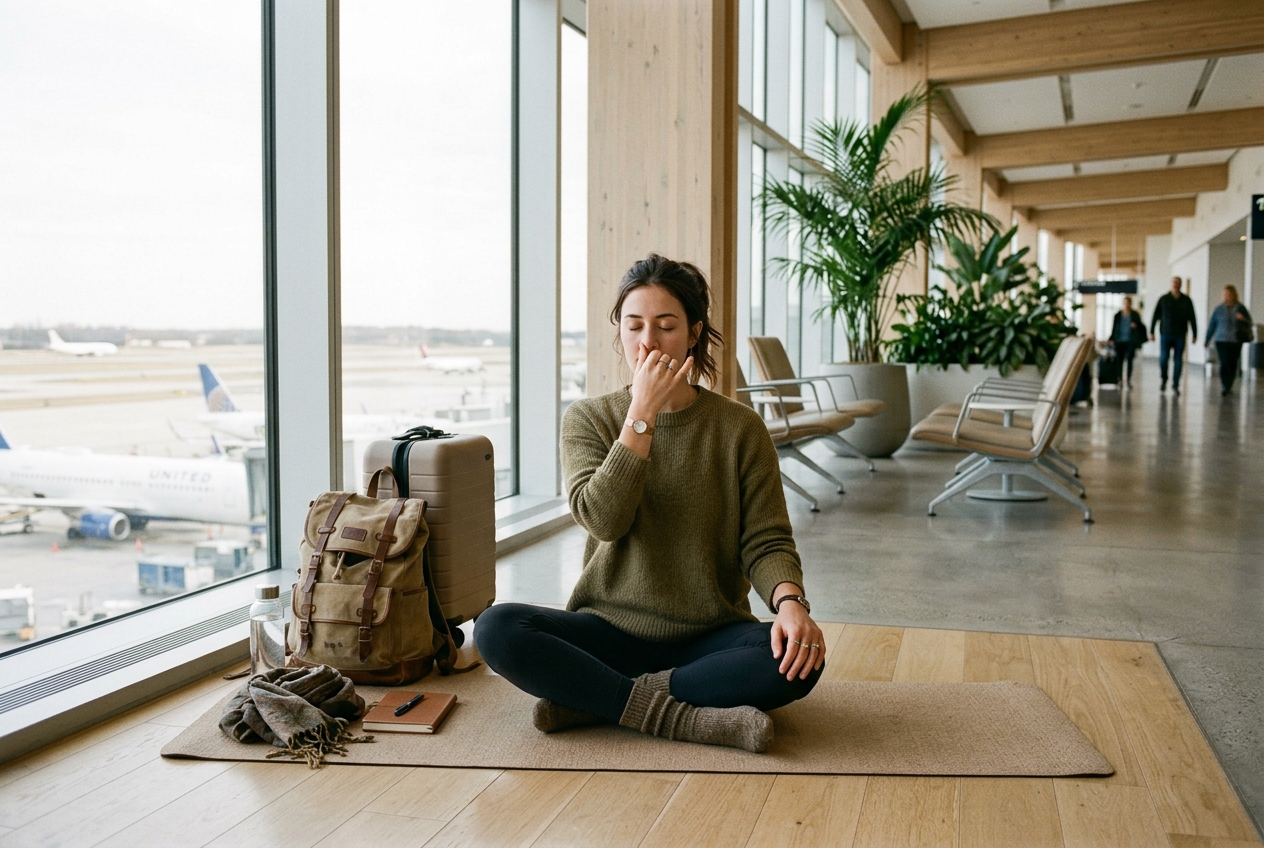
By integrating specific pranayama (breathwork) routines, travelers can decelerate their nervous systems and restore grounding. To physically decompress your hips and lumbar spine along with breathwork, you can also practice the Constructive Rest Pose (CRP).
🌬️ 1. The Science of Travel Vata Imbalances
In transit, the sympathetic nervous system (fight-or-flight) is highly stimulated by loud noises, crowds, and cabin pressure fluctuations. This stimulation halts blood flow to the digestive tract (the enteric nervous system), leading to bloating and constipation on the road.
To reverse this, we must activate the parasympathetic nervous system (rest-and-digest). Alternate-nostril breathing, or Nadi Shodhana, has been clinically proven to stimulate the vagus nerve, balance hemispheric brain activity, and slow the heart rate within minutes of practice, as detailed in research indexed on the National Center for Biotechnology Information (NCBI).
🧘 2. How to Practice Vata-Pacifying Nadi Shodhana
Follow this simple 10-minute grounding protocol after disembarking or in your transit hotel room:
- Find a Grounded Seat: Sit cross-legged on a yoga block, cushion, or firm chair. Ensure your spine is tall and your shoulders are completely relaxed.
- Hand Mudra: Raise your right hand and place the index and middle fingers between your eyebrows (Vishnu Mudra). Use your thumb to close your right nostril and your ring finger to close your left nostril.
- The Cycle:
- Close your right nostril with your thumb and inhale slowly through your left nostril for a count of 4.
- Close both nostrils and hold the breath for a gentle count of 4.
- Release your thumb and exhale slowly through your right nostril for a count of 8.
- Inhale through your right nostril for a count of 4.
- Close both nostrils and hold for 4.
- Exhale through your left nostril for a count of 8.
- Duration: Repeat this cycle for 10 full rounds, letting your attention rest entirely on the sensation of air touching your nostrils.
🌿 3. Supporting Ayurvedic Grounding Habits
Beyond breathwork, you can pacify Vata dosha during travel with these simple physical habits:
- Hydration with Warm Water: Avoid iced water, which aggregates cold Vata. Sip warm water or ginger tea throughout your travel day to keep your digestive tract hydrated.
- Anoint the Senses (Nasya): Apply a drop of sesame oil or ghee to the inside of your nostrils before boarding to protect your sinuses from dry cabin air.
- Warm Self-Massage (Abhyanga): After arrival, rub warm sesame oil onto your scalp and the soles of your feet. This simple touch practice grounds excess Vata movement. These tools are the foundation of your Ayurvedic Travel Toolkit. To study these healing methods further, refer to resources provided by The Ayurvedic Institute.
📊 Summary of Ayurvedic Travel Elements
| Dosha Imbalanced | Element | Primary Symptom | Daily Grounding Routine |
|---|---|---|---|
| Vata | Air & Ether | Jetlag, Bloating, Dry Skin | Nadi Shodhana, Warm Sesame Oil massage |
| Pitta | Fire & Water | Irritability, Heartburn | Rose Water spray, Coconut Water |
| Kapha | Water & Earth | Lethargy, Congestion | Walking meditation, Ginger Tea |
📚 References
- Ayurvedic Reference: Lad, Vasant (2002). Textbook of Ayurveda: Fundamental Principles. Ayurvedic Press.
- Clinical Breathwork Study: Journal of Clinical and Diagnostic Research (2018), “Impact of Alternate Nostril Breathing on Parasympathetic Parameters”.
- Somatic Context: Nervous System Reset: A 7-Day Somatic Travel Guide & Workbook by Akhi (2026).